Engineering & products
Delhivery's 2,000-EV Rollout Decoded: A Practical Fleet Electrification Roadmap for Indian Businesses
Delhivery's 2,000-EV rollout is a signal for every Indian fleet. Here's a practical fleet electrification roadmap for Gujarat businesses.
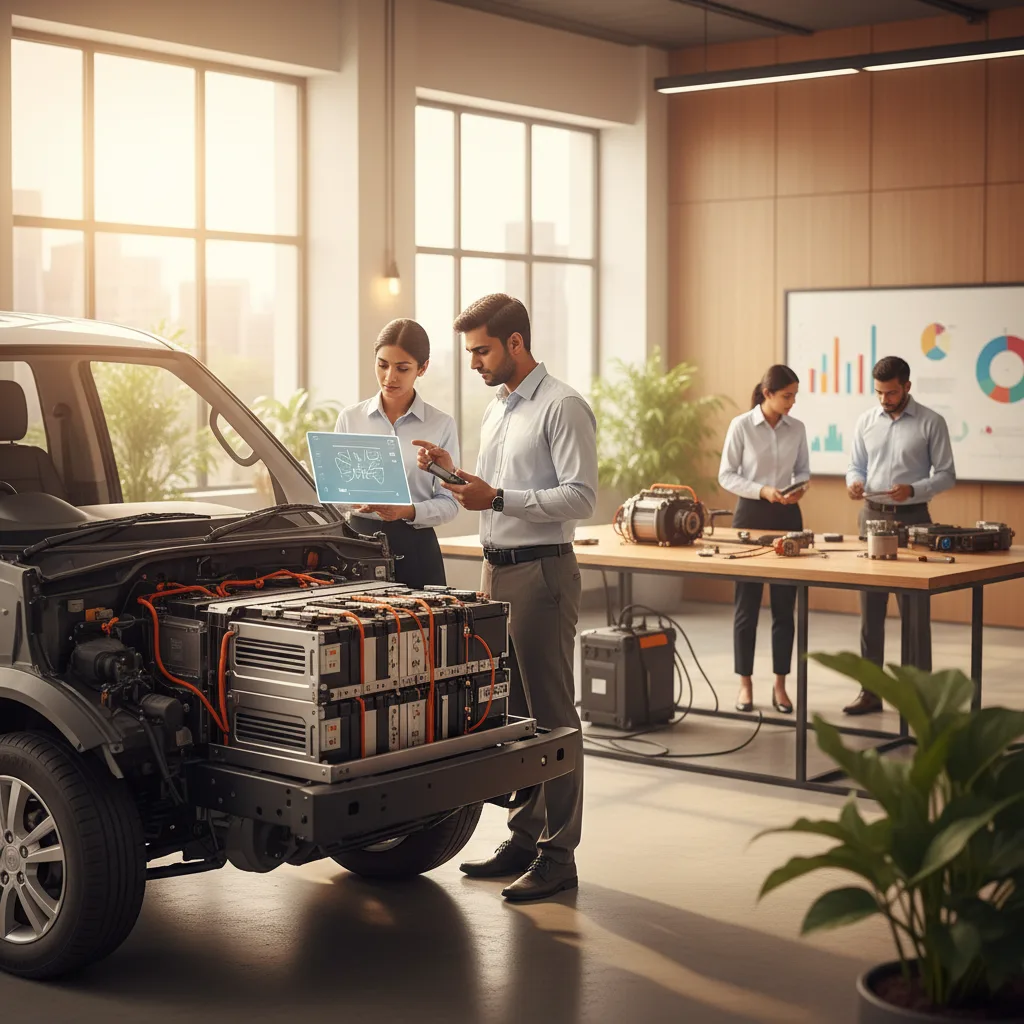
Two thousand electric vehicles don't land in a logistics network by accident. When one of India's largest delivery companies commits to that scale, its procurement team has already done the math on total cost of ownership, charging and uptime — and decided EVs win on economics, not optics. Fleet electrification in India has moved from CSR slide decks to purchase orders, and the playbook behind Delhivery's 2,000-EV rollout is one any Gujarat business with wheels on the road can copy at smaller scale.
Why Delhivery's 2,000-EV Rollout Matters for Indian Businesses
Delhivery, one of India's largest logistics companies, is partnering with three automakers to deploy 2,000 electric vehicles across its delivery network. For a sector that runs on thin margins and unforgiving service-level agreements, this is not a sustainability gesture — it is a cost and reliability decision taken at procurement scale.
The most instructive detail is the multi-OEM structure. Splitting 2,000 vehicles across three automakers de-risks vehicle supply, spreads service coverage across vendor networks, and protects delivery timelines if one manufacturer slips. The same strategy works just as well with 20 vehicles and two vendors.
Never bet your electrification programme on a single OEM's production queue.
The signal to the wider market is clear: electric mobility in India is shifting from CSR pilots to procurement-at-scale, pulled by e-commerce growth and last-mile delivery economics. When the biggest fleets move, financing products, service networks and charging follow — and the cost case for everyone else improves.
Gujarat is positioned to be an early beneficiary. Ahmedabad sits on the Delhi–Mumbai industrial corridor, with dense urban last-mile networks, a deep manufacturing base and a fast-emerging EV component ecosystem around it. If you run delivery vans, campus vehicles, school transport or intra-city logistics here, you are operating in one of the natural early-adopter regions for commercial EVs in the country.
The Business Case for Fleet Electrification in India
The sticker price of an electric vehicle is the wrong number to argue about. The right number is cost per kilometre over the vehicle's life: electricity plus maintenance on one side, diesel plus maintenance on the other, compared route by route. High-utilization vehicles on predictable urban loops break even fastest, because fuel savings compound every single day.
Four forces strengthen the case every quarter:
- Policy tailwinds: central EV incentives and Gujarat's EV policy can reduce upfront capex for commercial buyers. Verify current eligibility before modelling your numbers — schemes and caps change, and your business case should not depend on them anyway.
- Commercial pressure: large shippers and e-commerce platforms increasingly score logistics partners on emissions and energy cost per shipment. For enterprise contracts, a green fleet is becoming a qualification criterion, not a bonus point.
- Hedge value: electricity pricing is far more predictable than diesel. That predictability flows directly into annual budgeting and fixed-price customer contracts.
- Maintenance economics: fewer moving parts mean fewer scheduled services and less unplanned downtime — provided the battery and drivetrain are monitored properly.
New EVs vs EV Retrofit: Choosing Your Electrification Path
Once the numbers justify a move, you face a fork: buy new purpose-built EVs, or convert existing vehicles through EV retrofit. EV conversion in India is a real, regulated path — not a garage experiment — and for SMEs with young ICE fleets it can sharply lower the entry cost. The right answer depends on your fleet age, duty cycle and balance sheet.
| Factor | New purpose-built EV | EV retrofit (conversion) |
|---|---|---|
| Upfront cost | Higher | Lower — reuses chassis, body and cab |
| Warranty | Full OEM warranty on vehicle and battery | Depends on kit maker and retrofitter |
| Financing | Established EV loan and lease products | Emerging; often project-financed |
| Service network | OEM dealer footprint | Certified retrofitter network |
| Best fit | Fleet expansion, new route contracts | Young vehicles with proven duty cycles |
If you choose the retrofit route, insist on three things: type-approved conversion kits, retrofitters certified under the road transport ministry's retrofitment framework, and explicit RTO and insurer sign-off on every converted vehicle. Skip any one of these and your commercial EV conversion becomes a compliance and insurance liability.
Match the path to the duty cycle. Fixed-route, high-utilization urban vehicles electrify first: last-mile delivery vans, campus fleets, school transport, intra-city shuttles. Long-haul and heavy-payload use cases should wait until highway charging and heavy electric platforms mature — the economics and the EV charging infrastructure in India are not there yet for inter-city trucking.
In practice, hybrid rollouts win. Lease or retrofit a small pilot batch, prove the route economics with real data, then commit fleet-wide capex. That staged discipline is exactly what large fleets do — which is why their programmes survive contact with reality.
A 4-Phase Fleet Electrification Roadmap You Can Execute This Year
You don't need Delhivery's balance sheet to run Delhivery's process. This fleet electrification roadmap works for a 10-vehicle operator as well as a 200-vehicle one.
Phase 1 — Audit
Map every route, daily running distance, payload profile and downtime event. In most fleets, 10–20% of vehicles drive the bulk of fuel spend — shortlist those with data, not intuition.
Phase 2 — Model
Build per-route TCO comparisons — diesel vs new EV vs retrofit — covering charging, insurance, maintenance and resale value. Use your DISCOM's actual commercial tariff, not national averages, and stress-test diesel prices in both directions.
Phase 3 — Pilot
Run 5–10 EVs on your best-fit routes for roughly 90 days with telematics tracking range, charge time, uptime and energy cost per km. Ninety days is long enough to capture peak summer heat, monsoon driving and traffic variance — the variables spreadsheets miss.
Phase 4 — Scale
Negotiate multi-vendor procurement (the Delhivery lesson), set up depot charging, train drivers on regenerative braking and charging discipline, and lock in maintenance SLAs before volume deliveries begin.
Charging, EV Battery Systems and Telematics: Getting Operations Right
Charging strategy comes before vehicle selection. Start with overnight depot charging — it uses off-peak tariffs and fits the natural downtime of most commercial fleets. File your load-sanction request with your DISCOM early; grid approval is the single most common schedule-killer in Indian electrification projects. Add opportunity or fast charging only where routes genuinely demand it.
Treat the EV battery system as the asset inside the asset. Understand what voids the warranty, how cycle life maps to your duty cycle, and whether the pack has proper thermal management — a real consideration in a Gujarat summer. Battery health drives both daily uptime and resale value years from now.
EV fleet telematics turns the fleet into a measurable system. GPS, battery health and driver-behaviour monitoring feed dashboards for range, uptime and cost per km — the same numbers you modelled in Phase 2, now live. Track at minimum:
- Range achieved vs rated, per route
- Charge duration and energy cost per km
- Battery state of health and temperature trends
- Driver behaviour — harsh acceleration, braking and charging habits
- Uptime and route adherence against customer SLAs
Pair the data with predictive maintenance: schedule battery and drivetrain service before failures, not after, so route commitments and customer SLAs stay protected.
How Techynix Helps Gujarat Businesses Electrify Their Fleets
This is the work we do every day. Techynix — founded and led by Niraj Ojha from Ahmedabad — builds EV conversion, fleet telematics and operations software end-to-end, founder-to-founder. If you have been looking for an EV startup in Ahmedabad that owns both the hardware-side math and the software layer, that is precisely the gap we fill.
Because we are one full-stack studio, the pieces connect: EV retrofit feasibility, IoT-based vehicle and battery monitoring, charging dashboards, and EV fleet management web apps that share data instead of living in separate vendor silos. Our AI automation practice at Corp8 AI keeps us close to the same theme — turning operational data into decisions — whether that data comes from a warehouse or a battery pack.
The engagement model is deliberately practical: a feasibility study first, an instrumented pilot second, scale support third. Before anyone asks you to sign anything, you should have a per-route TCO model of your own fleet in hand.
Work with Techynix — book a call to scope your AI, software, IoT, EV or brand project. Bring your route and fuel data, and we will bring the electrification math.
Frequently Asked Questions
What is fleet electrification?
Fleet electrification is the process of replacing internal-combustion fleet vehicles with electric ones — either by purchasing new EVs or converting existing vehicles — and building the charging, telematics and operations around them so the fleet runs at equal or lower cost per kilometre.
How many EVs is Delhivery deploying, and with whom?
Delhivery is deploying 2,000 electric vehicles across its delivery network in partnership with three automakers. The multi-OEM structure de-risks vehicle supply and service coverage — a strategy smaller fleets can copy with two or more vendors.
Is EV retrofit or EV conversion legal in India?
Yes. EV retrofit is legal in India when done with type-approved kits and certified retrofitters, with the required RTO and insurer approvals for each converted vehicle. Unapproved conversions remain illegal and effectively uninsurable.
How much does it cost to electrify a fleet in India?
There is no single number — it depends on the path you choose. New purpose-built EVs carry higher upfront cost but come with OEM warranty and established financing; EV retrofit of existing vehicles lowers the entry cost. The right approach is a per-route TCO model covering electricity, charging infrastructure, maintenance, insurance and resale value against diesel, with current central and Gujarat incentive eligibility verified before you commit.
Which vehicles should a business electrify first?
Start with fixed-route, high-utilization urban vehicles — last-mile delivery vans, campus and intra-city shuttles, school transport — because predictable routes and high daily running deliver the fastest payback. Defer long-haul and heavy-payload vehicles until highway charging infrastructure and heavy electric platforms mature.
Written by Niraj Ojha
Niraj Ojha is a multidisciplinary engineer, founder, and product builder working across electronics, automotive engineering, manufacturing, software, and AI.
More writing
Gujarat's Deep-Tech Funding Shift: What AI, IoT and EV Founders in Ahmedabad Must Know Before Their Next Raise
Gujarat's funding is shifting from traditional industry to AI, IoT and EV deep tech. Here's what Ahmedabad founders must prove before their next raise.
India's EV Sales Surge 76%: Why Fleet Electrification Just Became a Bottom-Line Decision for Indian Businesses
India's EV registrations are up 76%. Here's why fleet electrification in India is now a bottom-line decision — and how Ahmedabad fleets start in 90 days.
Tech Expo Gujarat 2026: Why Gujarat's Founder-Led AI Ecosystem Push Matters for Ahmedabad Founders & SMEs
Tech Expo Gujarat 2026 is a founder-led push to build the state's AI ecosystem. Here is why it matters for Ahmedabad founders and SMEs — and how to act on it.