Engineering & products
Digital Twins for Indian Manufacturers: Smart Factory ROI Explained
A numbers-first guide to digital twins for Ahmedabad and Gujarat manufacturers — high-ROI use cases, payback math, a phased roadmap, and pitfalls to avoid.
What Is a Digital Twin in Manufacturing, Really?
Every experienced plant manager in Ahmedabad can tell when a machine is about to fail — by sound, by smell, by the way the floor feels. A digital twin in manufacturing turns that instinct into live data, flagging failures weeks early on every machine — and for the first time, the economics work for mid-sized Gujarat factories, not just global giants.
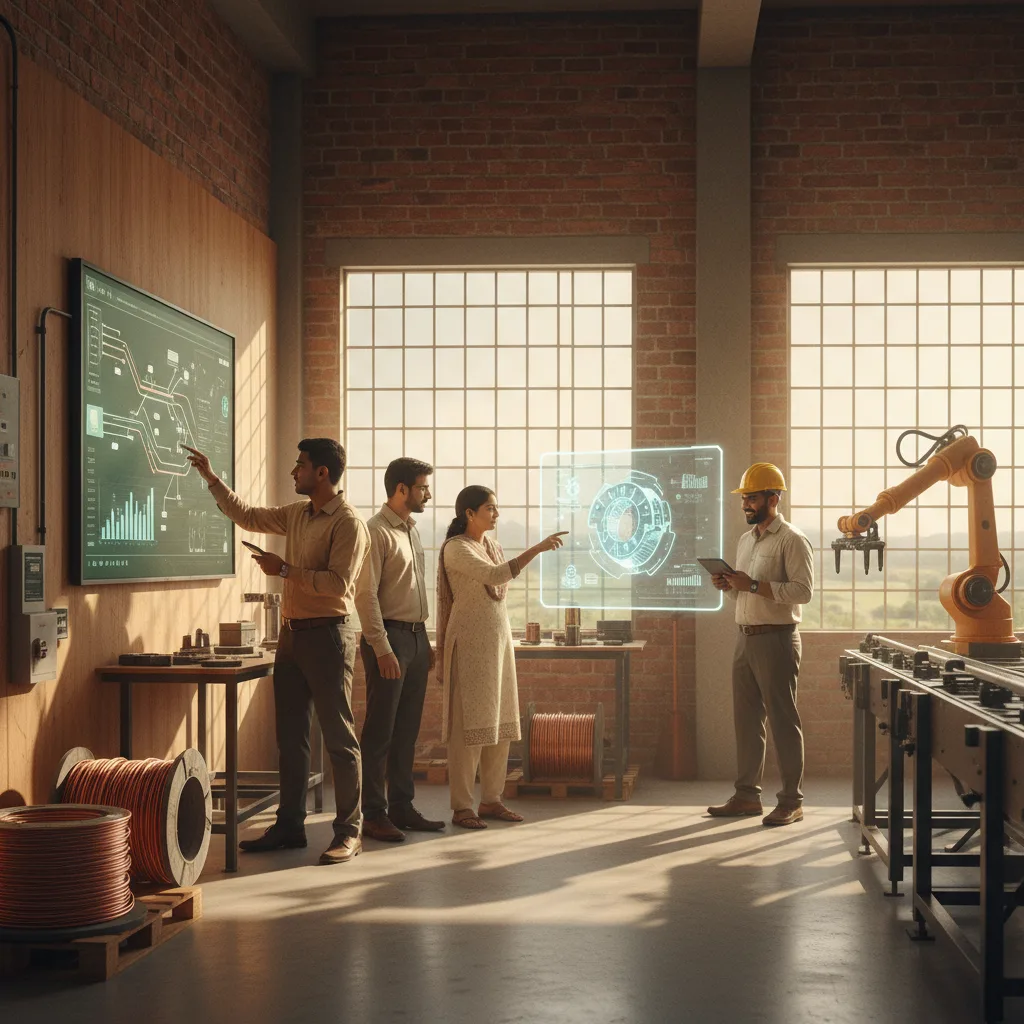
A digital twin is a live virtual replica of a machine, a production line or an entire plant, continuously updated in real time from sensor data. It is not a static 3D model on a sales brochure, and not a one-off simulation an engineer runs once and forgets. The twin mirrors the current state of your physical assets — temperatures, vibration, current draw, cycle times, throughput — and keeps updating as conditions change.
Most Indian factories already run on some combination of dashboards and Excel reports. Those tell you what happened last week. A digital twin tells you what will happen next. Because it models how your equipment and process actually behave, you can ask it real questions: what happens to output if we raise line speed by eight per cent? Can this week's batch schedule absorb a two-hour maintenance window? Which bearing fails first?
A dashboard tells you what happened. A digital twin tells you what happens next.
Underneath every twin sits an industrial IoT foundation: a machine monitoring system capturing vibration, temperature and cycle data; LoRa IoT connectivity where wiring across a large campus is impractical; and an RFID inventory system tracking material and batch movement. Get this layer right and the twin becomes a natural extension of it. Skip it and you have a pretty visualisation with nothing behind it.
This is why twins are now practical for mid-sized manufacturers. Sensors and connectivity cost a fraction of what they did a decade ago, cloud platforms are mature, and integration no longer demands a multi-year IT programme. You instrument one line, prove value, expand — which is exactly how smart manufacturing India projects should be run.
Why Ahmedabad & Gujarat Manufacturers Are Ideal First Movers
Gujarat is arguably India's most natural proving ground for this technology. The Ahmedabad–Vadodara–Rajkot corridor packs dense clusters — textiles and processing, chemicals, pharma, engineering castings, ceramics, auto components — into a few hundred kilometres. High machine density plus export exposure means a lot of equipment worth monitoring and a lot of margin riding on uptime and quality.
The economics of running a plant here have also hardened. Energy tariffs, skilled labour costs and compliance overheads keep rising while contract prices stay flat. When margins are thin, every avoided breakdown hour and every point of scrap matters more, not less.
Export customers are tightening expectations at the same time. European and American buyers increasingly demand traceability, quality data and audit-ready processes — batch genealogy, process parameters, proof of consistency. A twin built on RFID and IoT for manufacturing produces that evidence as a by-product of running the plant properly.
And the entry barrier has dropped. Central and Gujarat state policies now include incentives for Industry 4.0 India adoption, from technology-upgradation assistance for MSMEs to production-linked schemes. Smart factory solutions no longer compete against capex you actually need — state support for technology adoption has lowered the effective entry cost.
Where Digital Twins Actually Pay: High-ROI Use Cases
Not every use case earns its keep. These four consistently do, particularly in Gujarat's process-heavy, export-facing plants.
Predictive maintenance that actually predicts
Bearings, motors and pumps rarely fail without warning — they run hotter, vibrate differently, draw more current. Predictive maintenance IoT watches for exactly these signatures and flags the asset before it stops the line. The real win is not the avoided repair; it is converting a midnight breakdown into a scheduled forty-minute swap during a planned window.
What-if simulation without stopping the line
Testing a higher line speed, a new batch sequence or a layout change on the physical line costs you production every time. On the twin, you test virtually first, see the downstream effects, and commit the real line only to the version that works.
Energy optimisation for power-hungry processes
Textile processing, chemicals, ceramics — Gujarat runs energy-heavy industries. A twin that models your load profile can simulate load scheduling and shifting to reduce peak demand charges and overall power cost. Where power is one of the biggest conversion cost heads, this lever alone can carry the business case.
Quality and traceability for export compliance
Link RFID-tagged batches to process data captured on the line and you get batch genealogy: which material lot, which machine, which parameters, which result. That is precisely what export customers and auditors ask for — and it means faster root-cause analysis and fewer rejections for you.
The ROI Math: How to Calculate Payback Before You Spend
Digital twin ROI is not a leap of faith — it is arithmetic on losses you are already incurring. Build the case in four steps.
- Establish your baseline. Capture unplanned downtime hours per month, scrap percentage, energy per unit of output and OEE for the line in question. If you do not have these numbers, that is your first finding — and your Phase 1 deliverable.
- Map each use case to a rupee lever. Every initiative should attach to a loss you can already measure.
- Build the payback spreadsheet. Divide total project cost by the annual benefit it creates — nothing more sophisticated is needed for the go or no-go decision.
- Plan cost drivers honestly. Sensing hardware, connectivity (wired, Wi-Fi or LoRa), platform licensing and integration with existing systems. Phased spending beats big-bang every time.
| Use case | Baseline metric to capture | Rupee lever |
|---|---|---|
| Predictive maintenance | Unplanned downtime hours, maintenance spend | Avoided downtime hours × cost per stopped hour |
| What-if simulation | Output lost during trials and changeovers | Fewer failed experiments, faster ramp-ups |
| Energy optimisation | kWh per unit, peak demand charges | Energy saved per unit × monthly volume |
| Quality and traceability | Scrap percentage, rejections, chargebacks | Scrap points recovered × value of output |
Here is how the arithmetic works with illustrative numbers — swap in your own. Suppose your bottleneck line averages six hours of unplanned downtime a month, and one stopped hour costs ₹40,000 in lost contribution. That is roughly ₹29 lakh a year bleeding from a single line. If predictive maintenance on that line's five most failure-prone assets avoids even half of those hours, the annual benefit is about ₹14.4 lakh. Divide the pilot's total cost by that figure and you have a payback period in months, not vibes. You can build this model in an afternoon with your plant head and accountant.
A Phased Smart Factory Roadmap: Start Small, Prove, Scale
Factory automation projects usually fail from ambition, not technology. The fix is sequencing.
- Phase 1 — See. Instrument your most painful bottleneck line with a machine monitoring system. Capture downtime, cycle times, energy and process data; add LoRa or RFID where wiring is impractical. Deliverable: a trustworthy baseline you can defend in a board meeting.
- Phase 2 — Act. Layer on live dashboards, alerts and predictive maintenance for critical assets. Deliverable: your first avoided breakdowns and a measurable reduction in unplanned downtime against the Phase 1 baseline.
- Phase 3 — Simulate. Build the full digital twin — what-if scenarios for line speed, batch sequencing, layout and energy load scheduling. Deliverable: decisions tested virtually before they ever touch the shop floor.
How do you pick the pilot line? Choose the one where failure hurts most — your bottleneck, your highest downtime-cost asset, or the machine with the worst failure history. Then define success metrics your CFO actually cares about: downtime hours, scrap percentage, energy per unit and OEE, all measured against the Phase 1 baseline — never against a vendor's brochure.
Pitfalls That Kill Digital Twin Projects (and How to Avoid Them)
- Boiling the ocean. A plant-wide rollout on day one exhausts budget and patience before the first win. Prove value on one line, then expand with confidence.
- Buying dashboards without a data strategy. Garbage in, garbage out. A dashboard fed by badly placed sensors and uncalibrated tags is theatre. Start with the decisions you need to make, then decide what data answers them.
- Ignoring operators and supervisors. The shift team decides whether alerts get acted on or muted. Involve them from day one — show them their line, their metrics, and how the system makes their shift easier.
- Choosing vendors who have never stood on a factory floor. Manufacturing digital transformation is mostly context, not code. Ask a prospective partner where they have spent time on shop floors, how they handle legacy machines without PLCs, and what happens when the network drops mid-shift.
Start With One Line, Not the Whole Plant
We work with Ahmedabad and Gujarat manufacturers exactly this way: begin with a machine monitoring pilot on one painful line, prove the numbers, then grow into predictive maintenance, energy optimisation and a full digital twin. We build these programmes on Corp8 AI, a platform built for industrial IoT and manufacturing digital transformation, so the data captured in Phase 1 is the same data your Phase 3 twin runs on. No throwaway pilots, no orphaned dashboards.
If you are evaluating smart factory solutions for your plant, the first conversation should be about your baseline — your downtime, your scrap, your energy per unit — not our technology. Bring the numbers; we will bring the roadmap.
Work with Techynix — book a call to scope your AI, software, IoT, EV or brand project.
Frequently Asked Questions
What is a digital twin in manufacturing?
A digital twin is a live virtual replica of a machine, production line or entire plant, continuously updated in real time from sensor data. Unlike a static 3D model or a one-off simulation, it reflects the current state of your equipment and process — so you can monitor what is happening now and simulate what happens next, whether that is a line-speed change, a batch sequence or a maintenance window.
How much does a digital twin cost for a small or mid-sized Indian factory?
Cost depends on scope: how many machines you instrument, sensor types, connectivity (wired, Wi-Fi or LoRa), platform licensing and integration with existing systems. A single-line pilot built on a machine monitoring system costs a fraction of a plant-wide rollout, which is why a phased approach starting with your bottleneck is almost always the smarter spend. Insist on a scoped estimate based on your actual asset count rather than a generic price.
How is a digital twin different from a machine monitoring dashboard?
A dashboard reports what is happening or what already happened — downtime, cycle counts, alarms. A digital twin adds a working model of how your equipment and process behave, so you can run what-if scenarios and predict outcomes before touching the floor. In practice, dashboards are Phase 2 of the journey; the twin is Phase 3.
How long does it take to see ROI from a digital twin?
It depends on the size of your baseline losses. If unplanned downtime on a bottleneck line is costing lakhs a month, a predictive maintenance pilot can justify itself quickly; if your operations are already lean, payback takes longer and you should be honest about that. Fix your baseline metrics first, set a payback target before spending, and measure against real numbers — not vendor promises.
Which machines or lines should we start with for a digital twin pilot?
Start where failure hurts most: your bottleneck line, your highest downtime-cost asset, or the machine with the worst failure history. Export-facing lines that need traceability also make strong pilots, because RFID and process data deliver compliance value alongside ROI. The biggest wins often sit on older critical assets nobody has been watching — not the brand-new machines that already expose rich PLC data.
Written by Niraj Ojha
Niraj Ojha is a multidisciplinary engineer, founder, and product builder working across electronics, automotive engineering, manufacturing, software, and AI.
More writing
Predictive Maintenance IoT: The $20.4B Play for Indian Manufacturers
How predictive maintenance IoT helps Ahmedabad and Gujarat manufacturers cut unplanned downtime, age-proof legacy machines, and build toward a smart factory.
Second-Life EV Batteries: The BESS Opportunity for Indian Businesses
Retired EV batteries still hold years of value. Here's how Indian businesses — especially in Gujarat — can turn second-life packs into serious savings.
Retrofit-First Is India's Fastest Lane to Net Zero: The Business Case for EV-Converting Existing Fleets
India's diesel fleet won't vanish by 2070. The retrofit-first business case for EV conversion in India: costs, compliance, Gujarat's edge, and a pilot roadmap.