Engineering & products
Retrofit-First Is India's Fastest Lane to Net Zero: The Business Case for EV-Converting Existing Fleets
India's diesel fleet won't vanish by 2070. The retrofit-first business case for EV conversion in India: costs, compliance, Gujarat's edge, and a pilot roadmap.
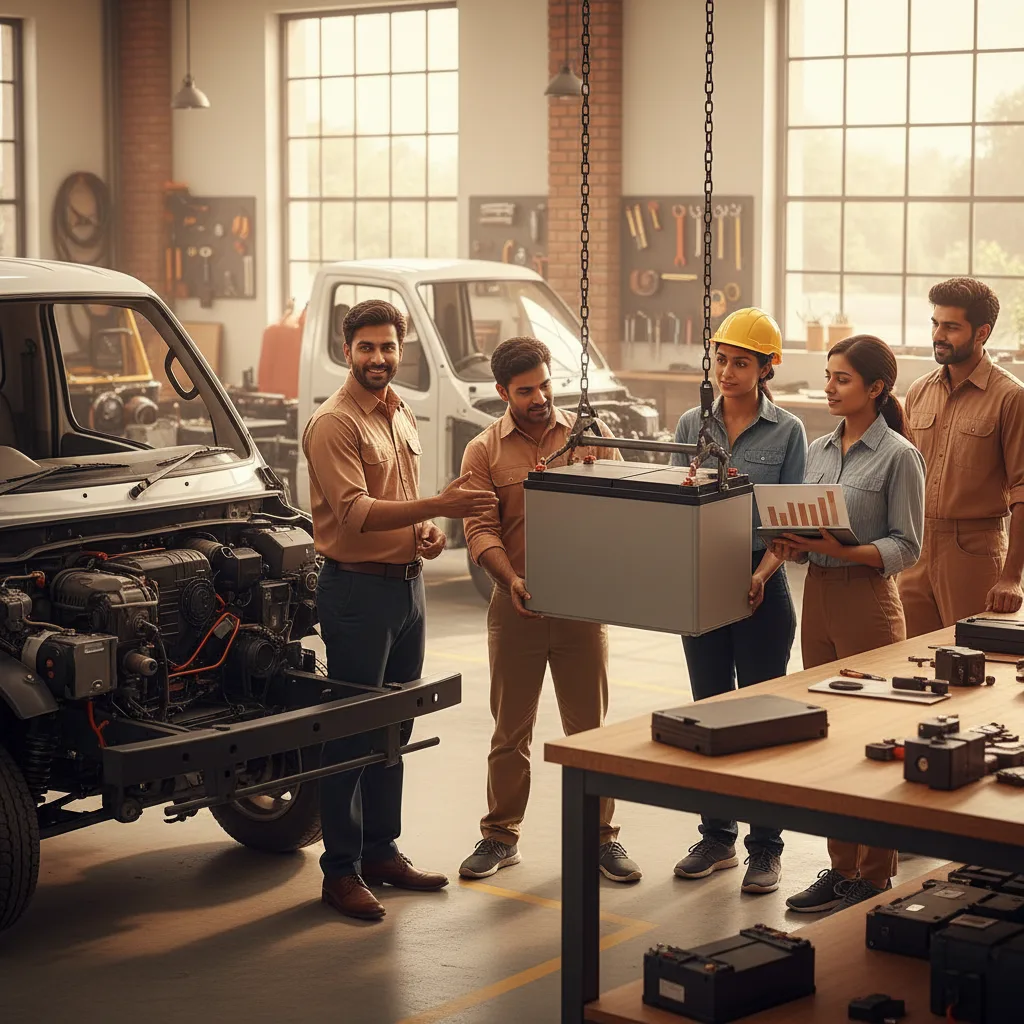
India will not reach net zero one showroom EV at a time. The diesel tempo idling at your factory gate today will still be earning in 2035, and EV conversion in India is the only lever that touches that installed base before 2070. For fleet owners in Gujarat, it also happens to be the cheapest route to a lower cost per kilometre — which is why we treat retrofitting as a business decision first and a climate decision second.
Why India's Net-Zero Math Doesn't Work Without Retrofitting
Commercial vehicles in India do not retire early. A truck or tempo built a decade ago is often still on the road today, and the scrappage wave only nibbles at the edges of a fleet measured in the millions. New EV sales, however fast they grow, are additive — they don't retire a single diesel kilometre already committed.
Every vehicle on the road also carries embodied carbon: the steel, the chassis, the energy already spent building it. Scrapping a functioning vehicle to replace it with a new one throws that investment away. Retrofitting keeps it. You swap the emissions source and preserve the asset — which is why a retrofit-first net zero strategy is the only one that moves the needle this decade rather than mid-century.
Gujarat makes this concrete. The Ahmedabad–Mehsana–Vadodara–Surat corridors run on aging diesel fleets serving logistics, pharma, textiles and manufacturing. These operators need answers now — fuel is already the largest line on their P&L — not a policy promise dated 2070.
The Business Case: Retrofit Costs vs Buying New Electric Vehicles
Run the comparison the way a founder would: what do you spend, what do you keep, and when does it pay back? A well-executed commercial EV conversion typically costs a fraction of a new electric vehicle in the same class, and the payback stack is straightforward — electricity is dramatically cheaper per kilometre than diesel, an electric drivetrain has a fraction of the moving parts to maintain, and you are not writing off a working vehicle to fund its replacement.
| Factor | Buying a new commercial EV | EV retrofit of your existing vehicle |
|---|---|---|
| Upfront capital | Full new-vehicle price | A fraction of the new-EV cost in the same class |
| Existing asset | Old vehicle scrapped or sold at residual value | Chassis, body and fit-out preserved |
| Permits and route approvals | Rebuilt from scratch | Carried forward with updated registration |
| Running costs | Low from day one | Low from day one post-conversion |
| Charging and telemetry | Specified by the OEM | Designed around your routes and duty cycles |
| Financing | Standard vehicle loans | Emerging retrofit leasing and pay-per-km models |
Beyond the purchase price, conversions protect the unglamorous capital nobody prices in: custom cargo bodies, cold-chain fit-outs, and the permits and route approvals tied to a registered vehicle. Buying new means rebuilding all of that. Retrofitting keeps it.
Financing is catching up, too. Retrofit leasing models are emerging that let SME fleet owners convert without a lump-sum hit — turning EV conversion cost in India from a capex argument into a cash-flow one.
How EV Retrofitting Actually Works: From Diesel to Electric
An EV retrofit in India is a powertrain replacement, not a hobby kit. Any serious electric vehicle conversion kit in India covers four systems:
- Electric motor and drivetrain — sized to the vehicle's gross weight and duty cycle, replacing the engine and often the gearbox.
- Controller and power electronics — the brain managing torque, regenerative braking and thermal limits.
- EV battery system — a pack with a battery management system, engineered for the vehicle's daily range and charging windows.
- Power harness and instrumentation — rewired low- and high-voltage systems, new gauges and safety interlocks.
Compliance is not optional. MoRTH has a defined retrofitment framework: conversions must be executed and certified by authorized agencies, and the vehicle's registration is updated to reflect its new electric drivetrain. Done properly, your retrofitted vehicle is fully legal and insurable. Done outside the framework, it is neither — and a fleet full of uncertified conversions is a liability, not an asset.
The best candidates are high-utilization, fixed-route vehicles: three-wheelers, light commercial vehicles, buses and material handling equipment. Predictable routes mean predictable range, which means right-sized batteries and honest economics.
Post-conversion, every vehicle becomes a data node. IoT telemetry tracks battery health, state of charge, range and utilization in real time — and a fleet intelligence layer like Corp8 AI turns that stream into cost-per-km dashboards your operations team can act on. Fleets that run on data outperform fleets that run on driver guesswork.
Why Ahmedabad and Gujarat Are India's Retrofit Sweet Spot
Some geographies are built for retrofitting, and Gujarat is one of them. It has quietly become a serious hub for electric mobility in India, for four reasons:
- Dense commercial vehicle base. The Ahmedabad–Gujarat industrial belt runs logistics, pharma, textiles and manufacturing fleets with high daily running — the exact profile where conversion economics work hardest.
- Policy tailwinds. Gujarat's EV policy incentives and industrial infrastructure make pilot projects easier to justify to a board.
- Engineering ecosystem. A deep local base of component manufacturers, fabricators and control-systems shops shortens conversion lead times and keeps support close to home.
- Obvious first movers. Factory material handling, campus fleets and last-mile delivery operators in Ahmedabad have controlled routes and depot charging — the easiest place to prove the model.
If you are building an EV startup in Ahmedabad, retrofitting is also the fastest wedge into the market: you sell to fleets that already exist, with an ROI story they can verify in ninety days.
Where Commercial EV Conversion Wins First
Not every vehicle deserves a battery. These four categories do, in rough order of payback speed:
- Three-wheelers and last-mile delivery. High daily running means fuel savings compound fastest here. Most fleet electrification strategies start here.
- Material handling equipment. Forklifts, tuggers and intra-factory transport run controlled routes with predictable charging windows — ideal duty cycles.
- Institutional and campus fleets. Shuttles and buses on fixed schedules with depot charging convert cleanly and visibly.
- Specialty and body-heavy vehicles. When the existing body, cold-chain fit-out or cargo system holds real value, retrofitting preserves capital a new purchase would force you to rebuild.
How to Choose an EV Conversion Partner (and Avoid Costly Mistakes)
The retrofit market is filling up with box-shifters — resellers moving generic kits with no engineering accountability. Here is the filter we would apply from your side of the table:
- Insist on end-to-end engineering. Battery system design, powertrain integration, compliance and telemetry should live in one team that owns the outcome — not four vendors pointing at each other.
- Demand a pilot-first approach. Convert a few vehicles, measure real-world results, then scale. Anyone pushing a fifty-vehicle commitment before proving one is selling, not engineering.
- Interrogate post-conversion support. Spares availability, battery warranty terms and remote monitoring are where conversion projects live or die after month three.
- Prefer founder-led engineering teams. You want people whose name is on the workshop door — teams that stay answerable after the invoice clears.
A Retrofit-First Roadmap: From Pilot Fleet to Full Electrification
Here is the sequence we recommend to operators evaluating EV conversion in Ahmedabad and beyond:
- Audit your fleet. Map age, utilization, routes and duty cycles. Shortlist high-utilization, fixed-route vehicles — and be honest about the ones that should retire instead.
- Run a 60–90 day pilot. Convert a few vehicles and measure hard KPIs: cost per km, uptime, real range, driver feedback. No vibes — numbers.
- Plan charging and battery strategy in parallel. Depot charging, charge windows and battery sizing must be designed alongside the conversion schedule, not bolted on afterwards.
- Build the board-level case from pilot data. Verified cost-per-km and uptime figures are what unlock financing for full fleet electrification — and lock in the terms.
A pilot that works changes the conversation from "should we?" to "how fast?" — which is exactly where your fleet electrification strategy should end up.
Let's Scope Your Retrofit Pilot
You don't electrify a fleet in a boardroom. You convert one vehicle, measure everything, and let the data make the case. Work with Techynix — book a call to scope your AI, software, IoT, EV or brand project, and we'll help you pick the right first vehicle, design the battery system, and run a pilot your CFO will believe.
Frequently Asked Questions
Is EV conversion legal in India?
Yes — when done under MoRTH's retrofitment framework. The conversion must be executed and certified by authorized agencies, and the vehicle's registration is updated to reflect the electric drivetrain. Outside this framework, a converted vehicle is illegal to run and effectively uninsurable.
How much does it cost to convert a vehicle to electric in India?
It varies with vehicle class, battery capacity, motor specification and whether you are converting one vehicle or a fleet batch. As a rule of thumb, a well-executed conversion costs a fraction of a new commercial EV in the same class. The honest way to get a number is a small pilot with real quotes — not an online estimate.
Which vehicles are best suited for EV retrofitting?
High-utilization, fixed-route vehicles: three-wheelers and last-mile delivery vehicles, light commercial vehicles, campus shuttles and buses, material handling equipment inside factories and warehouses, and specialty vehicles where the existing body or fit-out holds real value.
How long does an EV conversion take?
Engineering design and certification come first; once the design is frozen, individual conversions typically take a few weeks each, and fleet batches proceed in parallel. A pilot of a few vehicles, end to end including compliance, is usually a quarter-long exercise.
What is a retrofit-first EV strategy?
It means electrifying the vehicles you already own before buying new ones — preserving embodied carbon and existing capital, starting with the highest-utilization routes, proving economics on a small pilot, and then scaling to full fleet electrification on the back of verified data.
Written by Niraj Ojha
Niraj Ojha is a multidisciplinary engineer, founder, and product builder working across electronics, automotive engineering, manufacturing, software, and AI.
More writing
Delhivery's 2,000-EV Rollout Decoded: A Practical Fleet Electrification Roadmap for Indian Businesses
Delhivery's 2,000-EV rollout is a signal for every Indian fleet. Here's a practical fleet electrification roadmap for Gujarat businesses.
Gujarat's Deep-Tech Funding Shift: What AI, IoT and EV Founders in Ahmedabad Must Know Before Their Next Raise
Gujarat's funding is shifting from traditional industry to AI, IoT and EV deep tech. Here's what Ahmedabad founders must prove before their next raise.
India's EV Sales Surge 76%: Why Fleet Electrification Just Became a Bottom-Line Decision for Indian Businesses
India's EV registrations are up 76%. Here's why fleet electrification in India is now a bottom-line decision — and how Ahmedabad fleets start in 90 days.